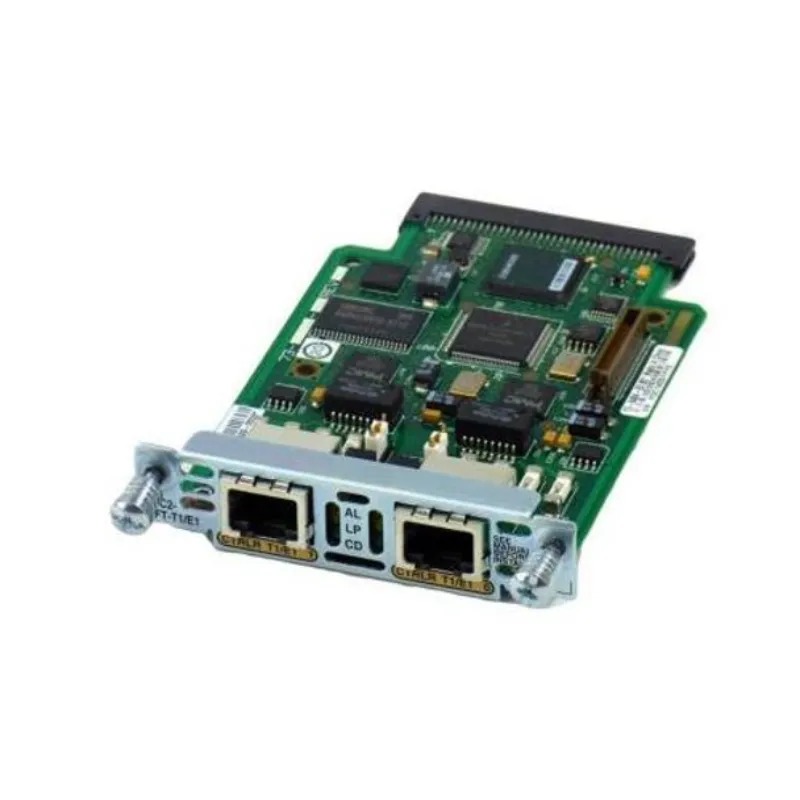
The Cisco MFT VWIC2 interface cards simplify branch-office connectivity by integrating the functions of a router, T1/E1, and fractional T1/E1 serial interface with a fully managed DSU/CSU.
When used for “data-only” WAN connectivity, the Cisco MFT VWIC2 cards support numerous functions, including Cisco IOS® Software Command-Line Interface (CLI)-initiated loopback control, similar to the popular Cisco 1-Port T1/Fractional T1 DSU/CSU WAN Interface Card (part number WIC-1DSU-T1). Additionally, the MFT VWIC2 also is offered in dual-port versions, including dual T1/E1 configurations, enabling increased WAN port density in Cisco 1800, 2800, and 3700 Series and Cisco 3800 Routers and supported Cisco 1700, 2600, and 3600 Series access routers. The T1/E1 MFT VWIC2 versions include integrated DSU functions for E1 deployments and integrated CSU and DSU functions for T1 deployments, simplifying remote network management.
The Cisco 2-Port MFT VWIC2 interface cards increase configuration flexibility on Cisco multiservice access routers, eliminating the need for two single-port T1/E1 WICs. Increasing the T1/E1 port density in a single WIC or HWIC slot enables applications such as local serial aggregation with the 2-port high-speed serial WIC or 2-port asynchronous/synchronous serial WIC (part number WIC-2T or WIC-2A/S), or ISDN backup with the Cisco 1-Port ISDN BRI S/T WAN Interface Card (part number WIC-1B-S/T-V3) or the 1-port ISDN with NT-1 WIC (part number WIC-1B-U-V2).
The Cisco MFT VWIC2 cards also support a channelized capability where the T1 or E1 service can be flexibly split into two or more fractional channel groups. Thus a single physical port can provide connection to multiple sites. (Note: If this mode is chosen, only a single port can be supported in each WIC slot and it works only on ISRG1s; it is not available on the Integrated Services Routers Generation 2 (ISR G2).)
The second-generation 1- and 2-port G.703 multiflex trunk voice/WICs (product numbers VWIC2-1MFT-G703 and VWIC2-2MFT-G703) support both unstructured E1 (G.703) and all the features of the other Cisco MFT VWIC2 cards, including drop and insert. Additional flexibility is provided on the 2-port G.703 multiflex trunk voice/WICs with the capability to configure one port for unstructured E1 (G.703) while configuring the other for standard framed E1.
Multiplexed Data and Voice Solutions: 2-Port T1/E1 Drop-and-Insert Multiplexer with Integrated DSU/CSU
The Cisco 1- and 2-Port MFT VWIC2 Interface Cards simplify branch-office connectivity by enabling a Cisco 2800, 3700, or 3800 and select Cisco 2600 and 3600 Routers to consolidate the functions of a router, a fully managed drop-and-insert multiplexer, and a fully managed DSU/CSU into a single box. (It is possible to use two Cisco 1-Port MFT VWIC2 Interface Cards for supporting the drop-and-insert feature. Generally a Cisco 2-port MFT VWIC2 is more appropriate because 2 ports are required.) Typically a drop-and-insert multiplexer is used for channelized (that is, TDM) integration of data and voice onto a single T1, fractional T1, E1, or fractional E1 connection to the central office. Sharing a line can significantly reduce costs over those of two separate physical lines to the central office. Although the normal use is for data and voice sharing of a T1 or E1 service, the drop-and-insert capability also can be used for video and data, or data and data sharing of the service.
Moreover, the integrated drop-and-insert capability enhances system availability by allowing the Cisco IOS Software to be reloaded while maintaining TDM switching.



Reviews
There are no reviews yet.